To what extent does a structured Art Inquiry Model increase student agency in creative decision-making?
A Year 10A Visual Arts inquiry by Sophia Coelho at Minaret College, Officer Campus, exploring how the STAR Art Inquiry Model, Gradual Release of Responsibility, and Grow's SSDL framework scaffold creative independence within the Social Injustice unit.

Acknowledgement of Country
We respectfully acknowledge the Boon Wurrung people of the Kulin Nation, the Traditional Custodians of the lands upon which the Inquiry process was held at Minaret College, Officer campus. We pay respect to the Elders past, present and emerging. We recognise the ongoing spiritual link Aboriginal People have to their lands, culture and lore, and acknowledge that their connections build healthier communities and sources of knowledge that we benefit from.
Mapped to the Evidence of Professional Practice requirements
Every component of the VIT PRT checklist is documented across this portfolio. Click each category to see the evidence and where it lives on this site.
Overall progress
20 of 20 components complete
80 days of teaching evidence
Logged across T1-T4 2025 at Minaret College Officer Campus
Inquiry question
Structured Art Inquiry Model and student agency in creative decision-making
View evidence →Teaching content & learning outcomes
Year 10A Visual Arts, Social Injustice theme, Victorian Curriculum 9-10
View evidence →The setting, the cohort, and the case for structured inquiry.
Minaret College, Officer is an independent Islamic school serving a culturally and linguistically diverse community. Year 10A Visual Arts is mixed-ability with Year 7–8 Art experience and Year 9 Media and Visual Communication experience. The inquiry begins by re-establishing foundational artmaking and conceptual thinking before deeper inquiry work can begin.
Independent Islamic school (F–12) integrating academic excellence with Islamic values, faith, respect, excellence, responsibility, community. ICSEA data indicates students benefit most from explicit instruction and structured visual scaffolding.
Baseline data: ~80% rated themselves “not confident” in developing original ideas. Prior cohort work was technically capable but conceptually empty, defaulting to reproducing flags and symbols rather than original meaning-making. The inquiry asks to what extent structure supports agency.
Highlights the learning gaps and instructional needs of 10A Visual Art students.
- Mixed ability group
- Missed Year 9 Visual Arts
- Age range: 15 to 18
- 10 boys, 8 girls
- Learning disability
- Language disability
- No consistent foundational skills
- Limited exposure to art-making processes
- Art is just painting and drawing
- Art is free time
- Art is not important
Structured & scaffolded instruction needed
- Mainly 1 to 2 point perspective
- Basic 3D modelling
- Lack of experience across materials, techniques, processes
Understanding the starting point
Before implementing the Art Inquiry Model, I surveyed Year 10A students about their confidence and creative independence.
Quantitative Findings
"When I am given a project without step-by-step guidance..."
Key insight
60% of students are not confident without step-by-step guidance, indicating significant reliance on teacher scaffolding and external direction.
Qualitative Themes
Student voice on creative confidence and barriers
Guidance Dependency
\"I feel misguided and I feel like whatever I am doing is wrong and not going on the right track.\"
Idea Formation Barriers
\"I cannot form ideas on my own. I am just not sure what to do but if it is little I can figure it out.\"
Conceptual Anxiety
\"I feel confused and sad because I cannot think for myself and without guidance, I am lost.\"
Creative Identity
\"I just find that I lack the creativity and idea to do art when I am not following a guide or some sort.\"
Implications for unit design:
The AIM process needed to be taught directly, with teacher modeling and guided practice before independent application.
I designed a deliberate progression from “I do” through “You do together” to “You do independently” across the unit.
Early phases focused on establishing creative confidence and proving students could think and decide, not just follow instructions.
Five forces shaping the Art Inquiry Model
The Art Inquiry Model was designed at the intersection of learner needs, curriculum expectations, school context and contemporary pedagogy. Each factor informed how lessons were structured and scaffolded.
Design
Generation Z learners
First generation to record lower cognitive performance than their parents, linked to chronic digital dependence and disrupted deep processing
Teacher Dialogue
Reframe "not creative", unlock possibilities
ICSEA + Context
93% LBOTE, diverse needs, Year 9 gap
Pre-survey findings
Confirmed need for scaffolding and gradual release
School Handbook
Curriculum mapping, sequencing, assessment
How these factors shaped the AIM framework
- ●GenZ context: Recent neurological and educational data shows Gen Z is the first modern generation to record lower cognitive performance and IQ scores than their parents, driven by chronic digital dependence and short-form content disrupting deep processing. Lessons responded with sustained, structured inquiry, multimodal expression and purpose-driven tasks around Social Injustice to rebuild deep cognitive engagement.
- ●Handbook alignment: The AIM phases (Connect, Investigate, Make, Reflect, Express) map directly to Victorian Curriculum Levels 9 to 10 and APST descriptors for systematic embedding into Year 10 practice.
- ●Teacher dialogue: Reframing "not creative" as "needs scaffolding," I taught the AIM process explicitly, allowing students to discover creative capacity within a safe structured framework.
- ●ICSEA + diversity: Explicit scaffolding, visual supports, modified assessment formats and conferencing ensured all learners, including those with disabilities and language disorders, accessed the inquiry meaningfully.
- ●Pre-survey reality: Pre-survey findings confirmed that most students needed explicit scaffolding before they could attempt independent creative work. This directly informed the decision to pair AIM with a gradual release approach.
Rely heavily on teacher direction, seek reassurance before committing to creative decisions, tend to copy or closely follow visual references.
Engage enthusiastically with structured tasks, growing confidence, understand AIM phases but do not yet consistently justify why they make particular decisions.
Show emerging independence, can initiate tasks and justify decisions using subject-specific vocabulary. Genuine conceptual development still developing.
Conceptual overview, how the models connect.
Before exploring the inquiry in detail, this map shows how the Art Inquiry Model (AIM) sits at the centre of the research, drawing on the Gradual Release of Responsibility (GRR) and a Convergent Learning Model to build agency in creative decision making, and ultimately, divergent learning.
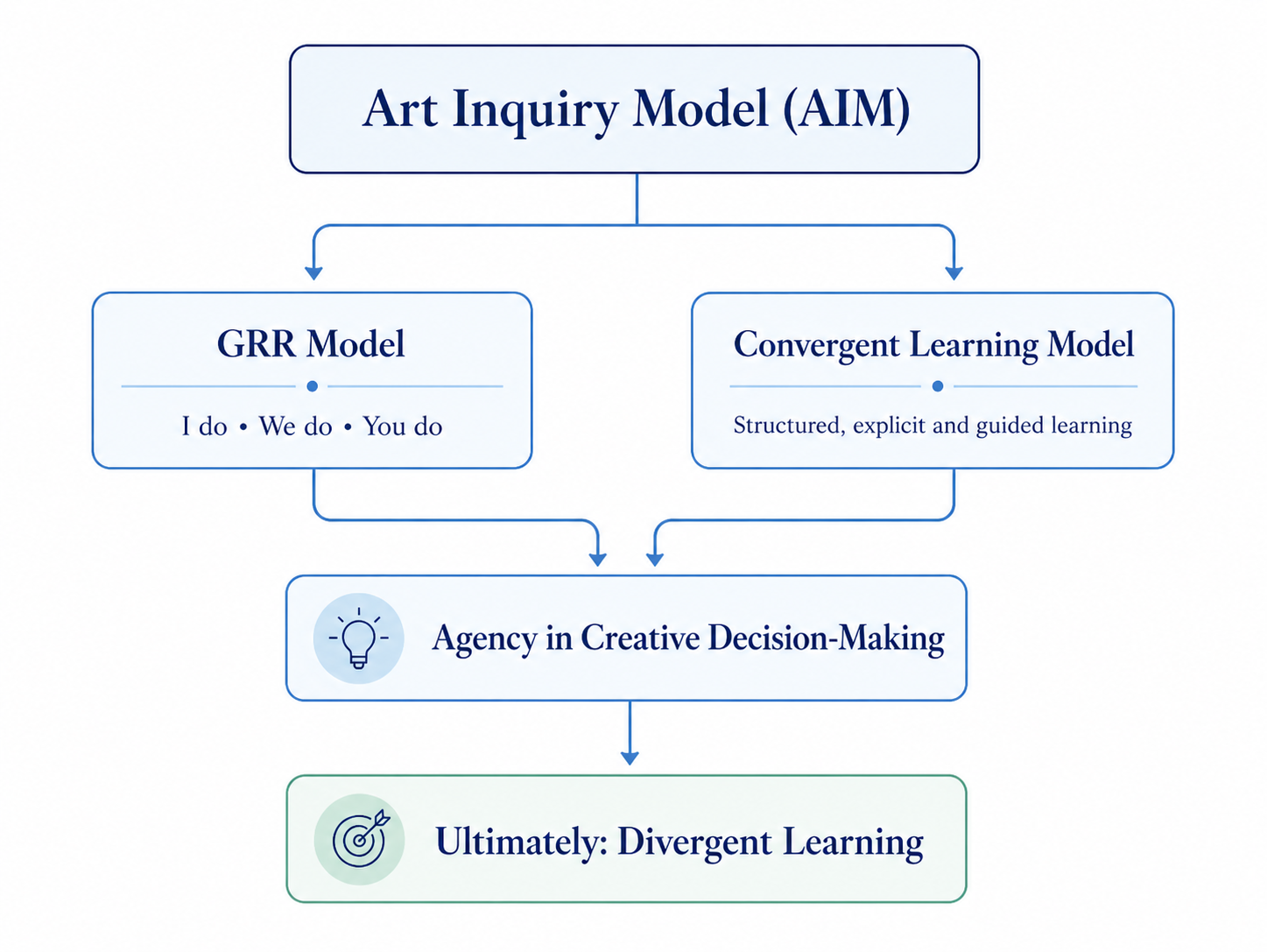
The GRR Model (I do, We do, You do) and a Convergent Learning Model both provide structured, explicit and guided learning pathways.
Both feed the Art Inquiry Model (AIM) which uses inquiry phases to organise how students think, make and reflect in art.
The intended outcome is increased agency in creative decision-making, leading to divergent learning where students confidently make original artistic choices.
The Art Inquiry Model is a structured framework for teaching and learning in art. It is not, and this distinction matters, the same thing as inquiry-based questioning.
Inquiry-based questions
Open-ended prompts used within a single lesson. Questions like ‘What do you notice first in this artwork?’ or ‘Why do you think the artist chose these colours?’ They are narrow in scope, deployed in the moment, designed to spark a specific kind of thinking.
The Art Inquiry Model
Broader than a single question. It is the structured model that organises the whole process of exploring, making, responding and reflecting in art. It covers the stages of an entire unit. Inquiry-based questions sit inside it, but the model itself is the sequence that takes a student from initial encounter with an idea, to making, to interpretation.
What is the Art Inquiry Model?
Lesson design and the Art Inquiry Model, made explicit.
The Art Inquiry Model is a thinking framework that helps teachers sequence learning. It organises inquiry into five steps and supports reflection on the processes of creating and teaching art. The image below sits alongside the framework to make it explicit before the lesson flow.
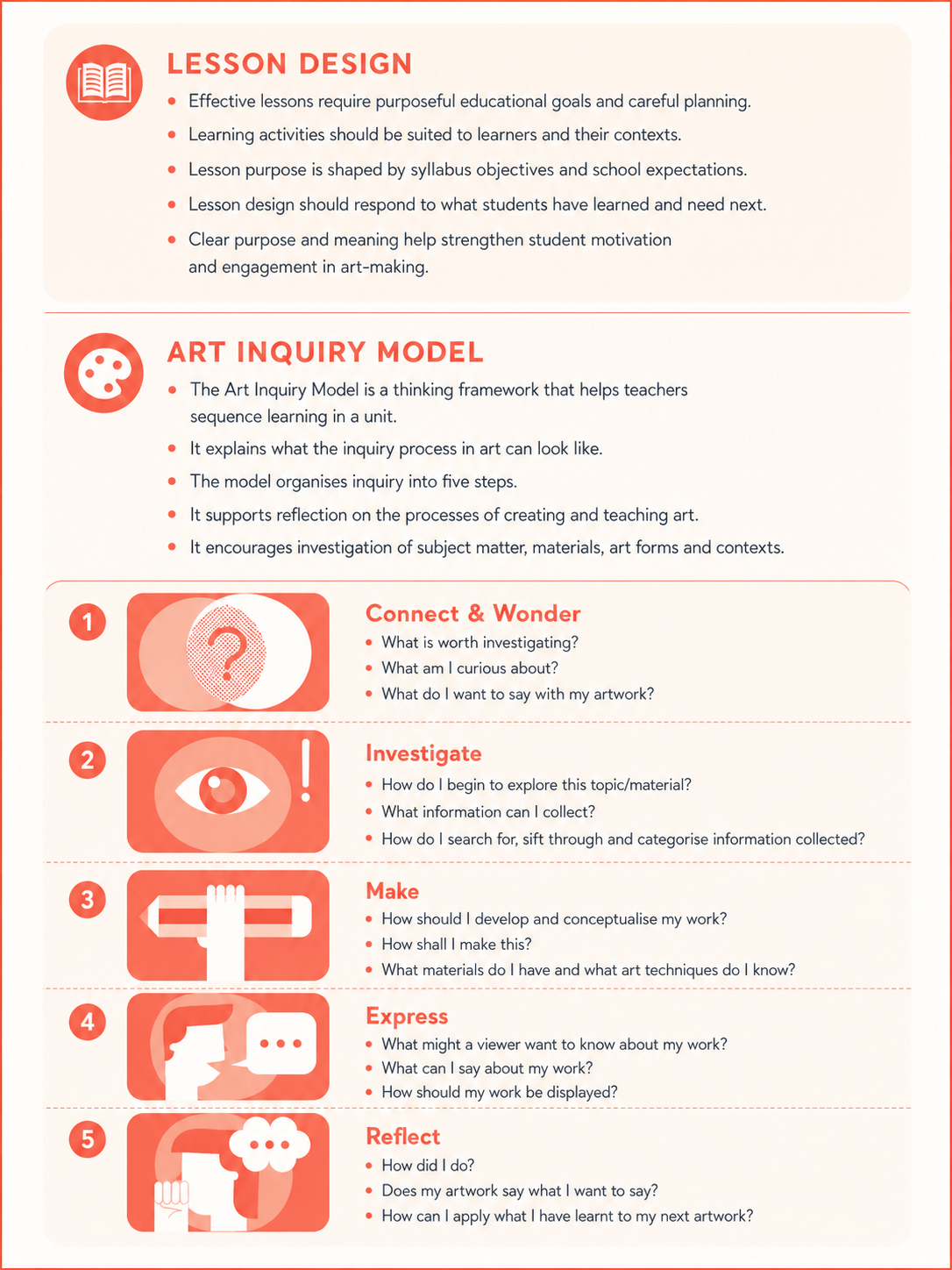
- • Effective lessons need purposeful goals and careful planning, not just activities.
- • Activities must suit learners and their context, including ICSEA, prior experience and disposition.
- • Lesson purpose is shaped by syllabus, school handbook and what students learned last lesson.
- • A clear inquiry purpose strengthens motivation and engagement in art-making.
- · What is worth investigating?
- · What am I curious about?
- · What do I want to say with my artwork?
- · How do I begin to explore this topic or material?
- · What information can I collect?
- · How do I sift and categorise what I find?
- · How should I develop and conceptualise my work?
- · How shall I make this?
- · What materials and techniques do I have?
- · What might a viewer want to know about my work?
- · What can I say about my work?
- · How should my work be displayed?
- · How did I do?
- · Does my artwork say what I want to say?
- · How can I apply what I have learnt to my next artwork?
This distinction was one of the key discussions and clarifications I had with my mentor during the early stages of the inquiry.
| Aspect | Inquiry Model for Art | Inquiry-Based Questions |
|---|---|---|
| Definition | A structured framework for teaching and learning in art. | Open-ended prompts that spark curiosity and critical thinking. |
| Focus | The whole process of exploring, making, responding, and reflecting in art. | Encouraging dialogue, interpretation, and investigation. |
| Scope | Broad: covers the stages of an entire unit or lesson. | Narrow: specific prompts used within individual lessons. |
| How it Works | Guides students step-by-step through creative and reflective processes. | Asks students to think, analyse, and interpret without a single "right" answer. |
| Examples | Stages: Exploring → Making → Responding → Reflecting. | "What do you notice first in this artwork?" / "Why do you think the artist chose these colours?" |
| Goal | To engage students in meaningful artmaking and interpretation. | To deepen understanding and foster inquiry-driven discussions. |
STAR's Art Inquiry Model, delivered through Gradual Release, calibrated to SSDL stages.
This section shows how the three models work together, not what AIM is (that is defined above). The GRR does not replace the AIM. It delivers it. Grow's SSDL model calibrates how much teacher direction each learner needs at each phase.
Theme exploration; guided artist analysis; class discussion connecting Social Injustice to personal experience.
Skill demonstrations and self-directed material experimentation in the visual diary; peer sharing.
Development and refinement of final artwork; decision-making conferences; compositional planning.
Annotated visual diary, structured peer critique, teacher conferencing, self-evaluation against rubric.
Writing and refining artist statement, installation and exhibition, verbal artist talk to peers.
Teacher models artmaking thinking aloud, making creative decision-making visible.
Teacher and students work through artist analysis together, with questioning rather than directing.
Pairs and small groups during peer critique and collaborative experimentation.
Students make and justify their own artistic decisions in Make and Express phases.
| Stage | Learner | Teacher |
|---|---|---|
| 01 | Dependent | Authority / Coach |
| 02 | Interested | Motivator / Guide |
| 03 | Involved | Facilitator |
| 04 | Self-Directed | Consultant / Delegator |
Baseline observations placed the majority of Year 10A at Stage 1–2. The AIM combined with GRR is designed to move students progressively toward Stage 3–4 by the Express phase.
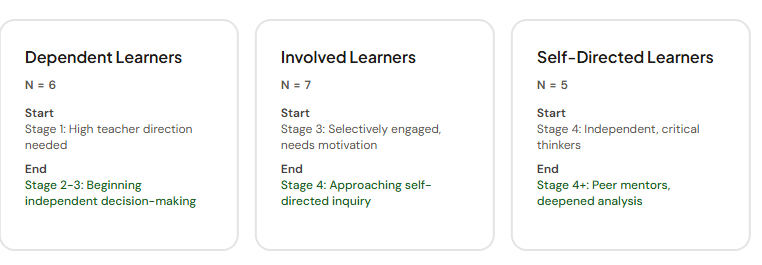
Baseline classroom observations sorted 18 students into three profiles: N=6 Dependent, N=7 Involved, N=5 Self-Directed. Start and End stages show the growth each group made across the inquiry.
View SSDL diagram in the Research Map →The Gradual Release of Responsibility, moving students along.
Drag the slider to see how the teacher role and student role shift across the four GRR stages, with a real example from the unit and the corresponding SSDL stage.
- • Models artmaking and thinks aloud
- • Makes creative decision-making visible
- • Demonstrates technique on the board
- • Watches and listens
- • Annotates examples
- • Asks clarifying questions
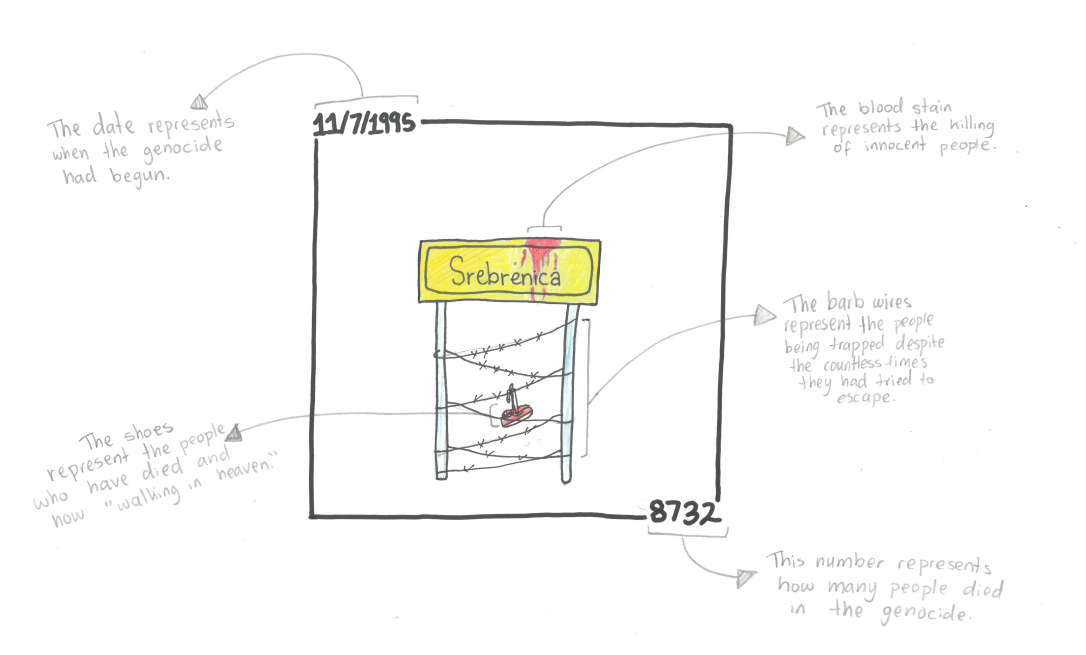
ExampleWeek 1, Srebrenica context. Teacher unpacks the artwork by Admir Delić and narrates how a viewer reads symbolism.
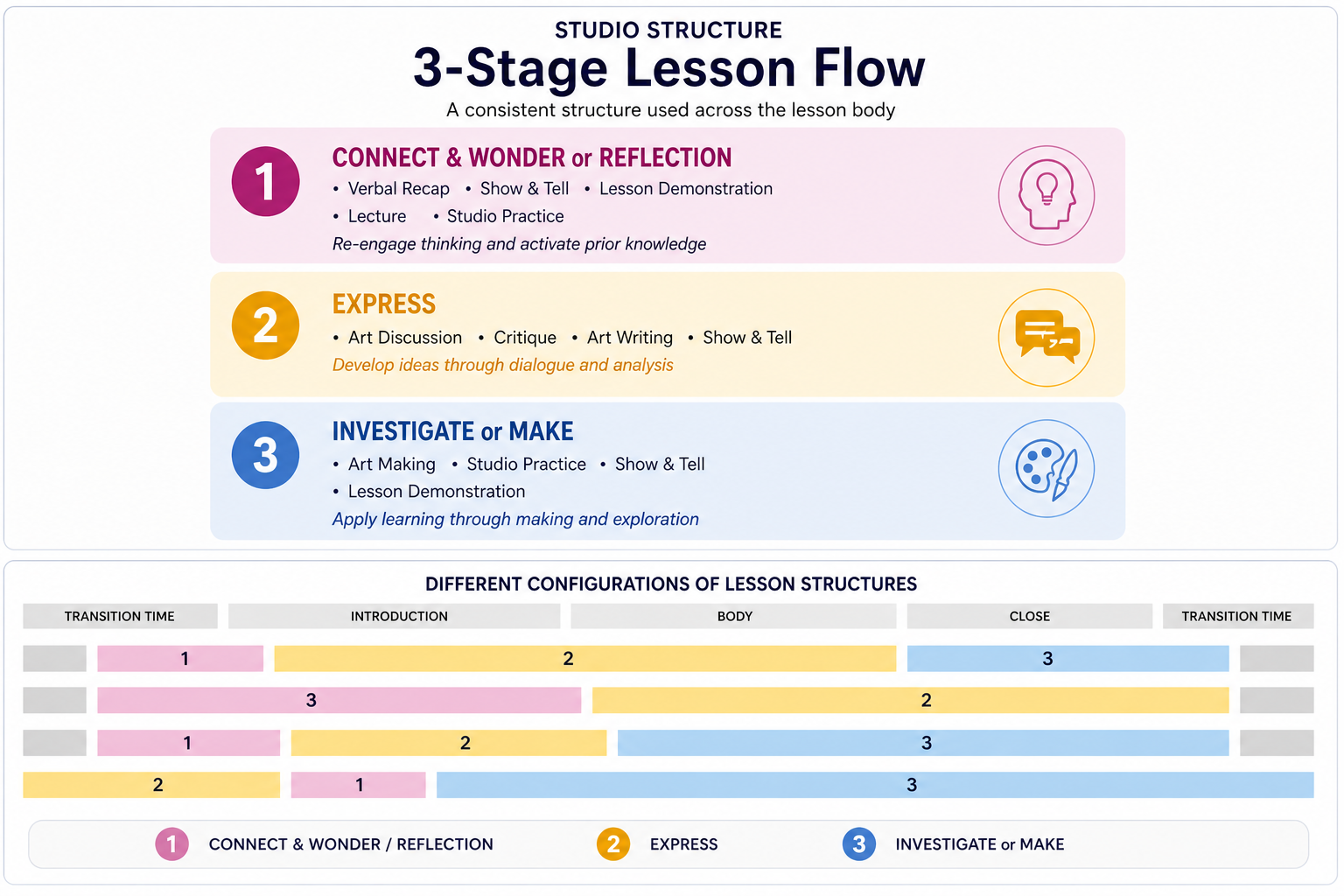
The 3-Stage Studio Structure, flexibly configured across each lesson.
The AIM operates at two levels. At the unit level each week is assigned to a primary inquiry phase; at the lesson level, three operational stages are configured flexibly. Drag to reorder the stages, or pick a preset to see how a real lesson is shaped across Transition, Introduction, Body and Close.
- Stage 1Connect & Wonder / ReflectionTheme exploration, guided artist analysis, visible-thinking routines and reflective re-entry.
- Stage 2ExpressArticulating intention, artist statements, peer critique, structured discussion, exhibition.
- Stage 3Investigate or MakeMaterial experimentation, technique demonstrations, sustained studio practice and refinement.
The three stages do not follow a fixed order, sequence and weighting are adjusted to serve the current AIM phase.
Foreground Stage 1 & 2 to build conceptual understanding before engaging with materials.
Build the lesson, test the flow.
Pick a teaching scenario, drag the three stages into the order you would teach them, then check whether your sequence matches what an effective lesson would look like.
You are introducing the Social Injustice theme to Year 10A for the first time. Most students are at SSDL Stage 1 to 2.
- 1💡Stage 1Connect & Wonder / Reflection
- 2💬Stage 2Express
- 3🎨Stage 3Investigate or Make
Interactive lesson plan, T3-T4
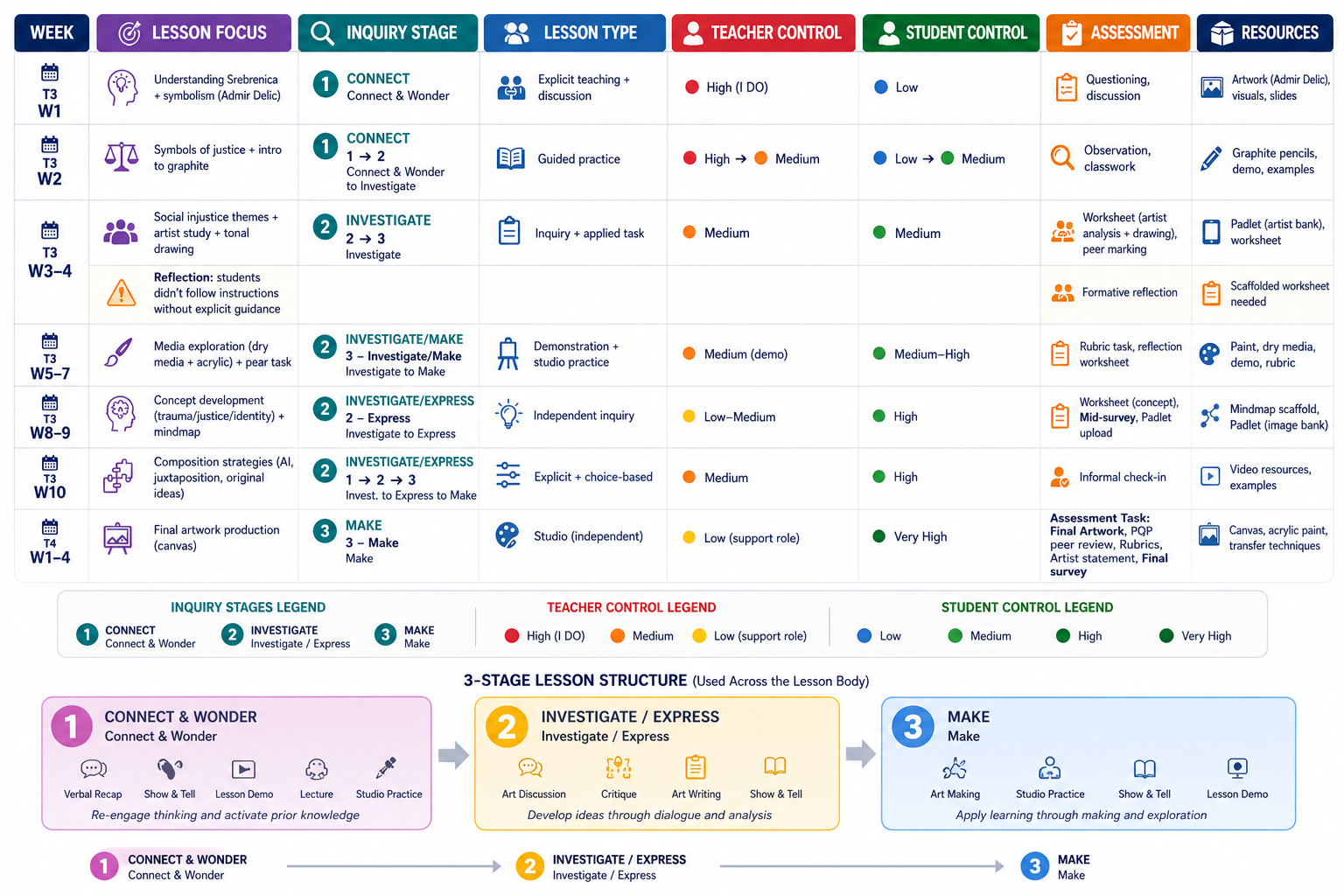
Explore how the Art Inquiry Model was implemented across 12 weeks. Each lesson represents one stage of the AIM progression, strategically sequenced to scaffold student agency and build independence.
Gradual Release of Responsibility progression
T3 W1
T3 W2-4
T3 W5-10
T4 W1-4
Success criteria
By the end of this unit, I expect students to demonstrate growth in the following areas.
Students articulate creative choices with reasoning.
Students self-initiate experimentation with materials, techniques, or concepts.
Students integrate peer and teacher feedback into their evolving work.
All learners produce a complete final artwork with original conceptual intent.
Assessment overview
I use a range of formative and summative strategies to monitor student growth across the unit.
Formative
- Visual diary checks (ongoing)
- Peer review (PQP protocol)
- Agency observation rubric
Summative
- Final artwork rubric
- Artist statement rubric
All assessment data is triangulated against pre, mid, and post surveys to track shifts in student confidence, creative risk-taking, and perceptions of agency over time.
From data to design to delivery
The structured action plan that drove this inquiry, from informing data through to reflective cycles of refinement.
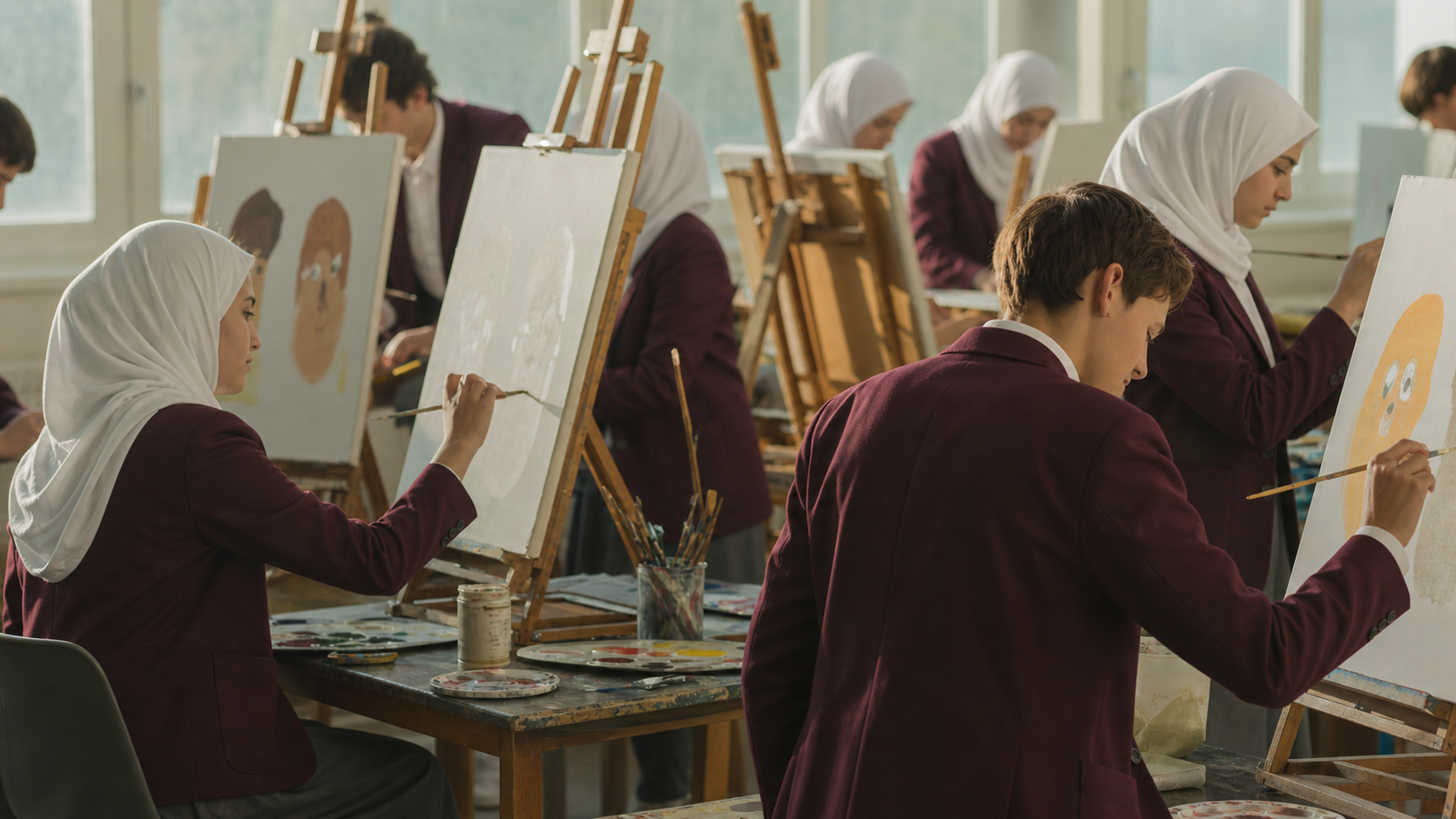
Studio practice in action
Year 10A Visual Arts, Term 3-4 2025
Informing Data
Pre-survey revealed 60% lacked confidence without step-by-step guidance. Diagnostic drawing tasks evidenced significant skill gaps from absence of Year 9 Visual Arts. Conferencing surfaced reluctance to make independent creative choices.
Professional Learning
Engaged with Visible Thinking (Project Zero) routines, ATSI Art into the Classroom course, and Fisher & Frey GRR research. Translated learnings into the Art Inquiry Model and worksheet suite.
Purpose of the Inquiry
To investigate whether explicit, structured scaffolding via the AIM and GRR builds rather than constrains student agency. The unit theme of Social Injustice was chosen to demand conceptual depth and original meaning, making.
Inclusive Practice
Three SSDL focus groups (Dependent, Involved, Self-Directed) with adapted resources, modified assessment formats, oral submission options, and conferencing pathways. APST 1.4, 1.6 and 2.4 directly addressed.
Success Criteria
(1) Students articulate creative choices with reasoning. (2) Students self, initiate experimentation. (3) Students integrate peer/teacher feedback. (4) All learners produce a complete final artwork with original conceptual intent.
Resources
Padlet image bank, scaffolded worksheets, demo videos, ELMO document camera, dry/wet media kits, four rubrics (Artwork, Visual Diary, Artist Statement, Agency).
Strategies
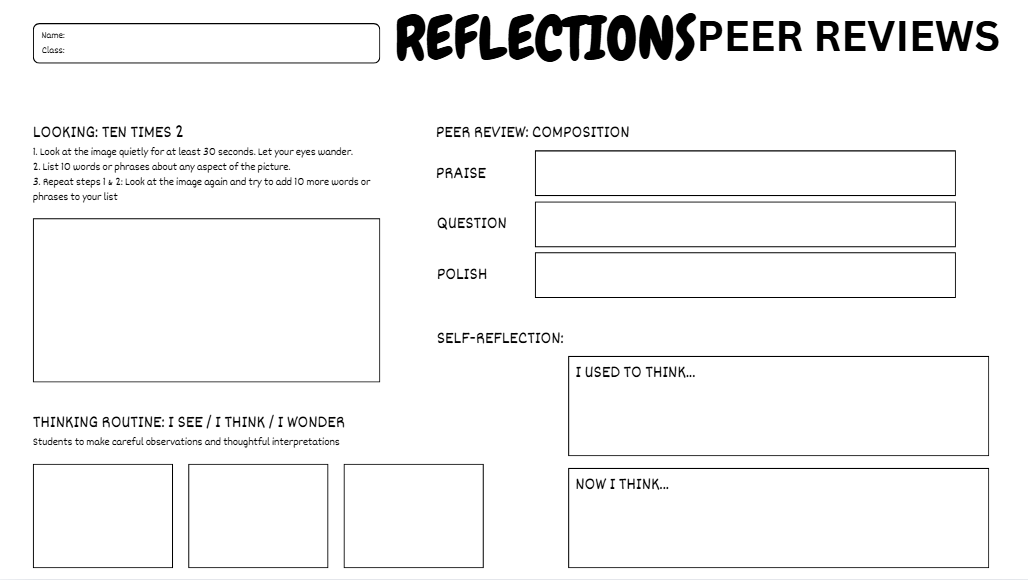
Explicit modelling, guided practice, gradual release, visible thinking routines (Looking Ten Times 2, I See/I Think/I Wonder, PQP), conferencing, peer critique.
Activities
AIM-aligned tasks across 12 weeks: Srebrenica symbolism study, dry/wet media exploration, concept mindmaps, composition design, final canvas production, artist statement, peer review.
Assessment
Formative: visual diary checks, peer review, agency observation rubric. Summative: final artwork rubric, artist statement rubric. Triangulated against pre/mid/post surveys.
Reflections
APST-aligned reflection prompts (5.4, 6.4, 5.1, 5.2, 1.4, 1.6, 6.4) drove cycles of mid-unit adjustment. Mid-point: more explicit scaffolding added at T3 W3-4. Post-unit: oral conferencing identified as next bridge to written reflection.
Strategies for APST 1.4, 1.6 and 2.4
Three priority APST descriptors required by the VIT checklist, with concrete strategies enacted in this inquiry.
Aboriginal & Torres Strait Islander students
- ●Embedded ATSI artists in the Padlet image bank, including Reko Rennie and Tony Albert
- ●Pointillism unit drew explicit links to Aboriginal dot painting techniques
- ●Acknowledgement of Country and cultural protocols modelled at unit start
- ●Differentiated to enable cultural perspectives without tokenism
Students with disability
- ●Modified rubrics and oral submission options for students with language disorders
- ●Visual scaffolds and graphic organisers for students with intellectual disabilities
- ●Conferencing pathways for written-task scaffolding (dot-point templates)
- ●Adjusted timelines and chunked tasks for processing differences
Reconciliation: ATSI histories & cultures
- ●Cross-cultural unit linking Pointillism with Aboriginal dot painting
- ●Padlet bank curated to include contemporary Indigenous Australian artists
- ●Cultural knowledge assessed via the Art Movement Combined Artwork rubric
- ●Reconciliation themes integrated into Social Injustice unit conceptually
From conceptually empty to thematically driven, the gap this inquiry was designed to close.
Two works from a previous Year 10 cohort, produced under a curriculum that prioritised technical skill without an overarching conceptual theme, illustrate the gap. Under the structured AIM framework the current cohort selected Social Injustice sub-themes, including students who chose to explore their own cultural and family backgrounds with respect and cultural affirmation.
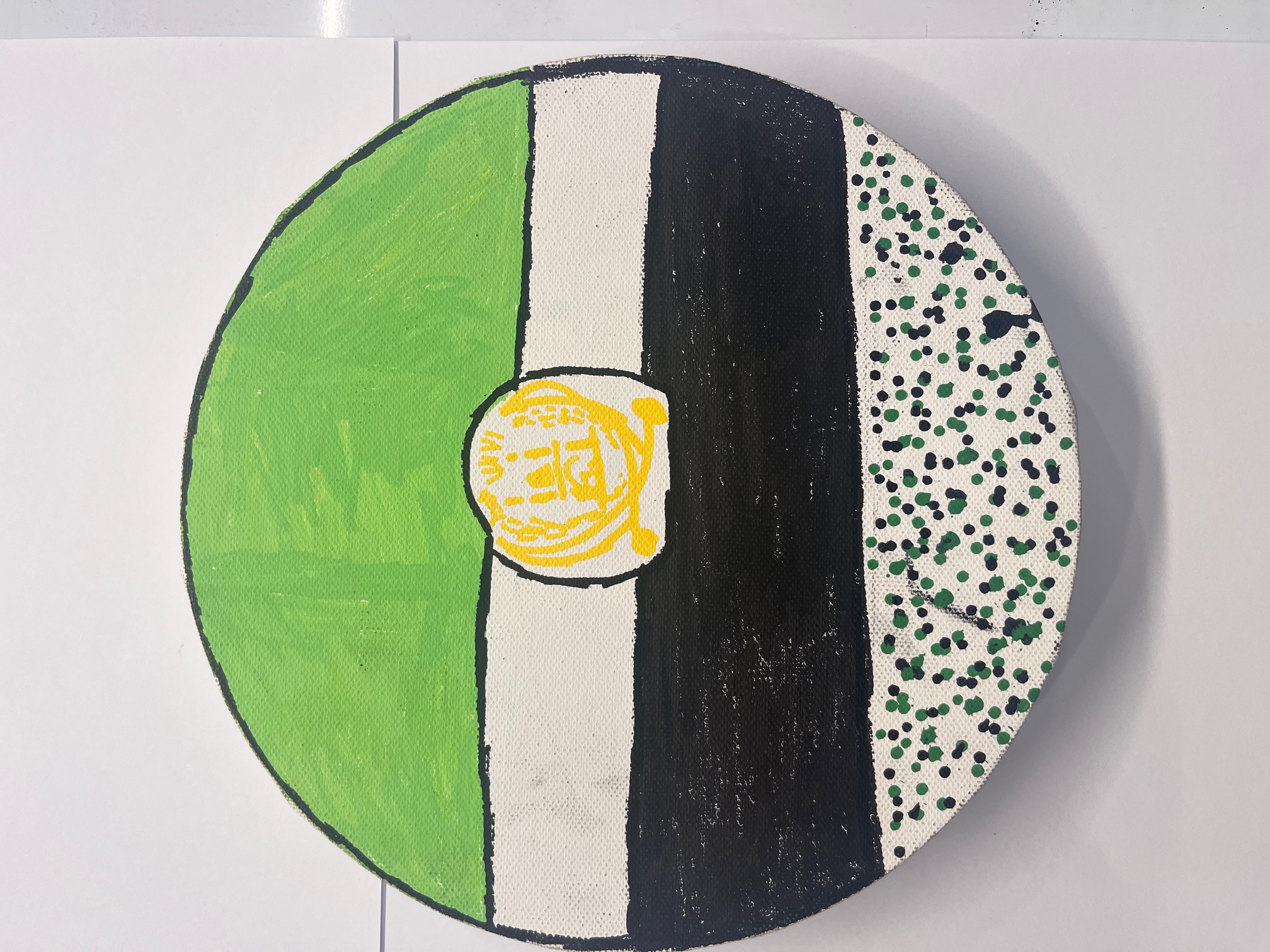
Confident brushwork and an unconventional circular canvas format. Yet the dotted lower register is a decorative compositional decision rather than a thematically driven one.
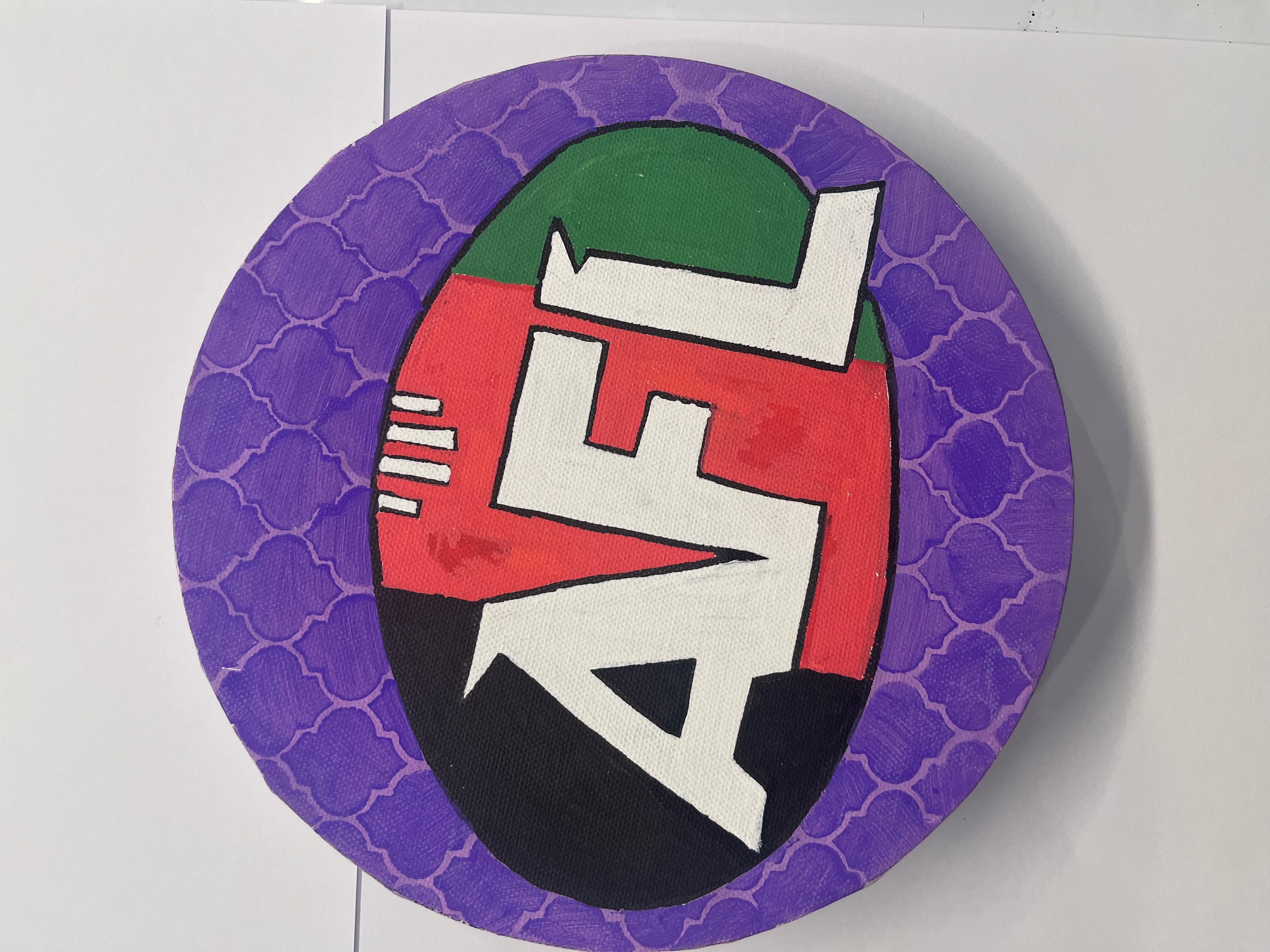
Interesting visual juxtaposition on a purple Moroccan-patterned background. Appears to emerge from formal experimentation rather than from inquiry into what the symbols mean together.
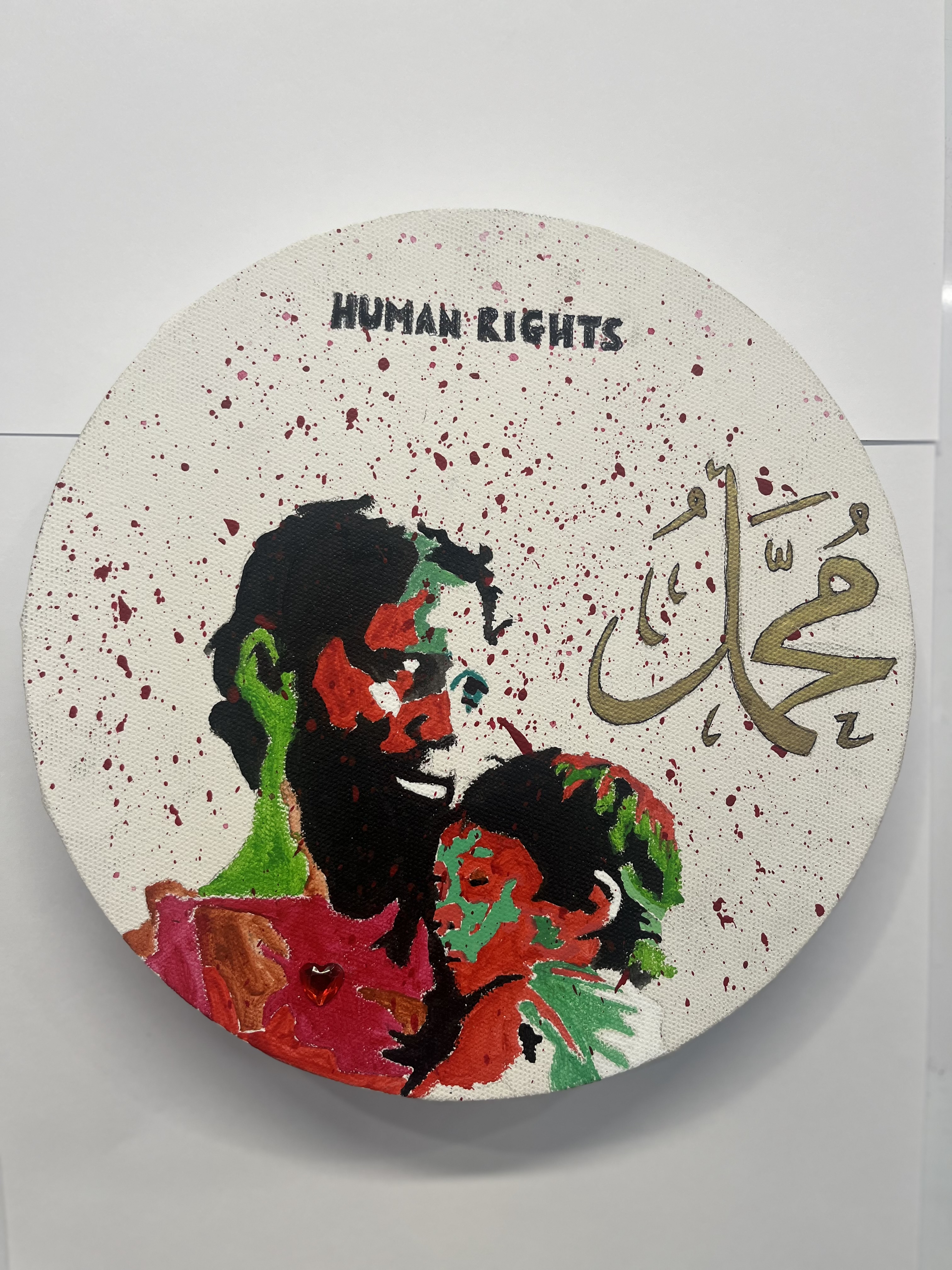
A deeply personal response to human rights violations. Ra. has independently sourced reference imagery, designed a circular composition with Arabic calligraphy, and used expressive colour and splatter technique to convey urgency and emotional weight. Every creative decision, from palette to symbolism, is intentional and self-directed.
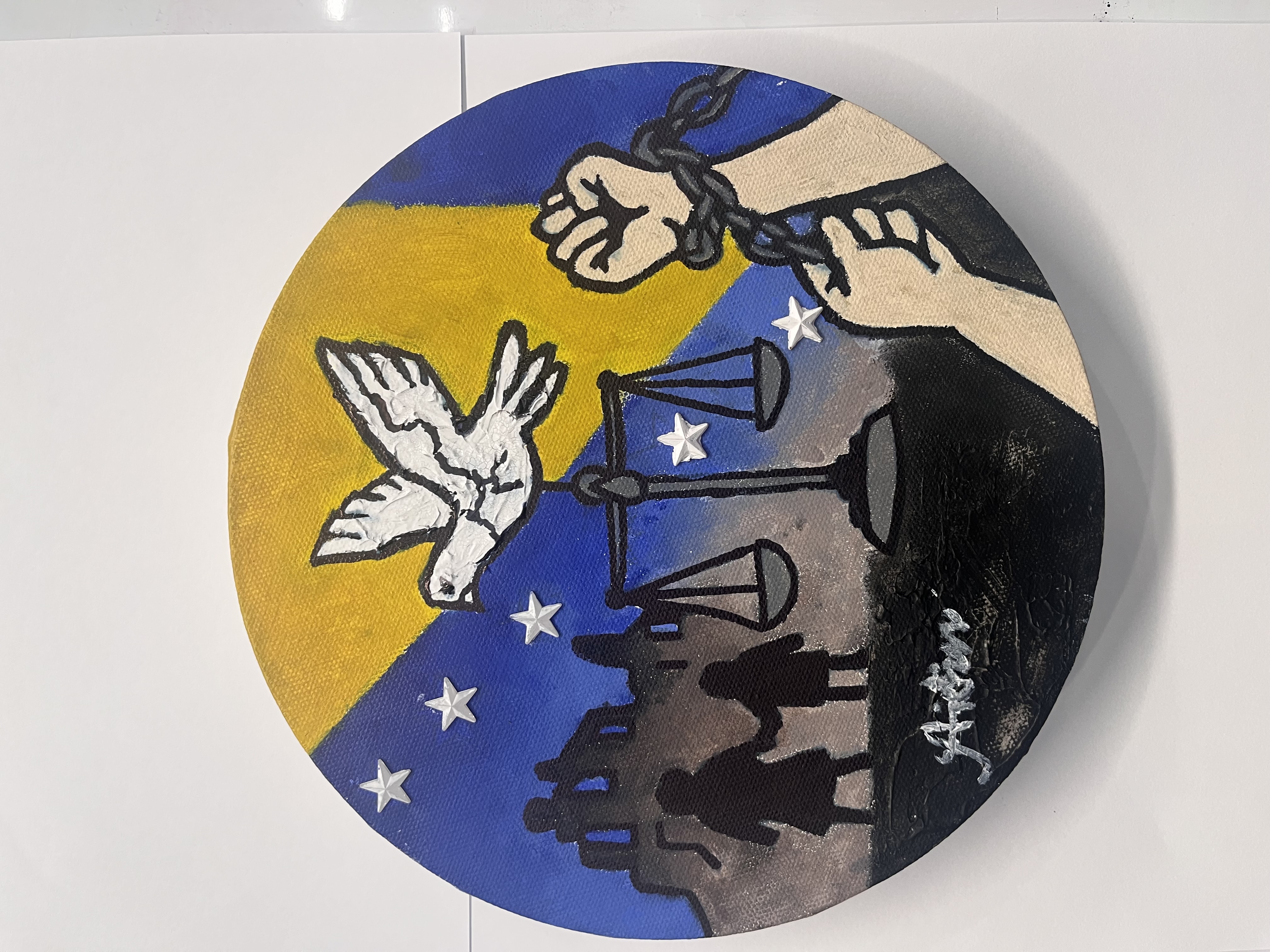
Ai. has designed a multi-layered composition exploring justice and freedom through powerful symbolism: chained hands breaking free, a white dove, the scales of justice, and the Bosnian flag colours. The composition moves from darkness to light, a deliberate narrative arc that demonstrates genuine conceptual thinking and independent creative decision-making.
Without a conceptual framework, a theme, a question, an inquiry, even technically capable students default to reproduction and decoration rather than original meaning-making. The critique is of the curriculum structure, not the students.
Featuring artworks responding to Trauma, Justice, Peace, Resilience and Identity, including pieces drawn from students' Afghan and Palestinian backgrounds, framed as cultural affirmation.
Open galleryVisible progress across the unit
Explore how students in each learner group progressed through the SSDL model and gained confidence across five key dimensions.
Student Progression Through Grow's SSDL Model
Year 10A Visual Arts · Minaret College · Term 3-4 Art Inquiry Unit
Exceptional cross-stage progress · With sustained teacher aide support
Key finding across all groups: The Srebrenica sketch emerged as the pivotal agency moment in the unit. The shoe motif was chosen independently by students across all three learner groups without teacher direction, providing the strongest evidence that structured scaffolding can lead to genuine creative independence.
Before & After Confidence Metrics
Drag the slider to compare student confidence levels across five key dimensions (mid-point surveys).
Technical Confidence
Creative Idea Generation
Independent Decision-Making
Persistence Through Challenge
Peer Feedback Integration
Key insight: The largest growth occurred in “Creative Idea Generation” (+31 percentage points) and “Independent Decision-Making” (+23 points), validating the inquiry's focus on student agency within structured scaffolding.
Unit Timeline, Transformation Moments
T3 W1-2, Explicit Scaffolding Established
Students learn the AIM process through direct modeling and low-stakes practice.
T3 W3-4, Confidence Turning Point
Students begin generating independent ideas within the Srebrenica inquiry. Dependent learners ask for feedback rather than waiting passively.
T3 W5-7, Creative Identity Shift
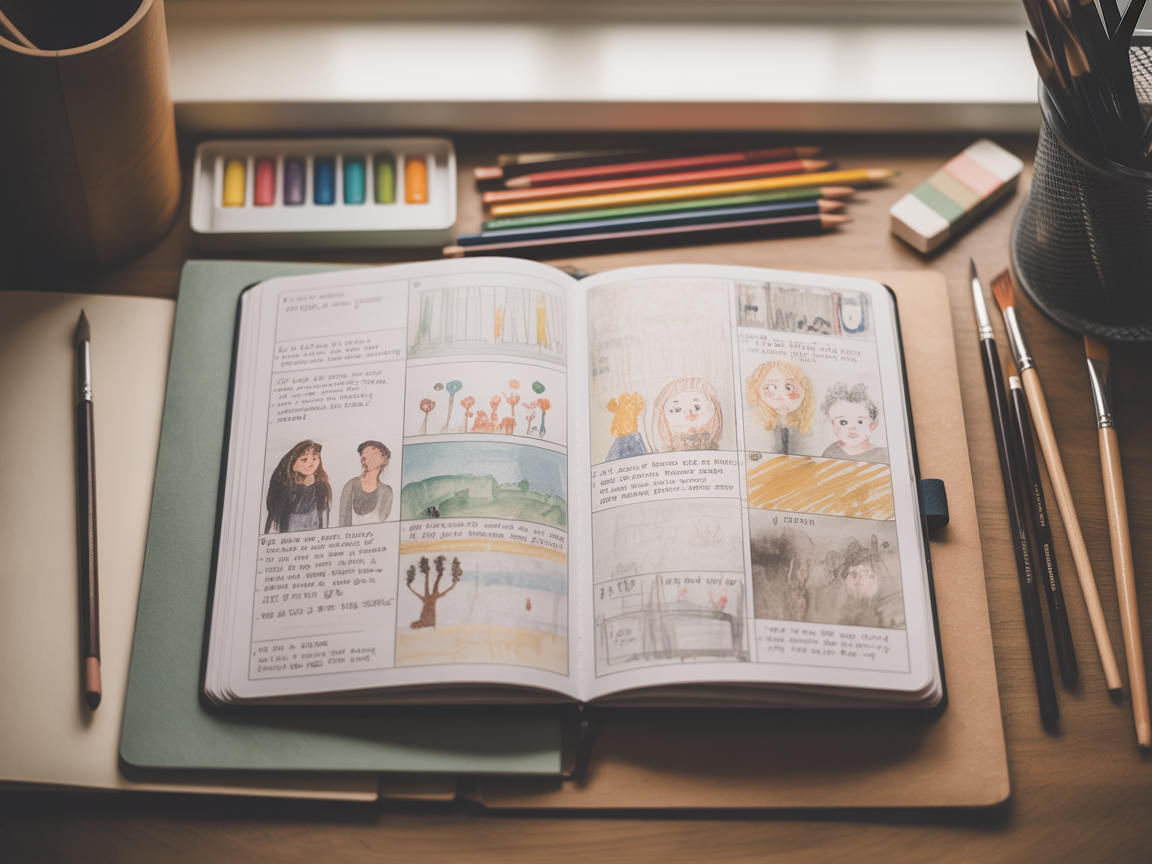
Media exploration phase, students experiment freely in visual journals. Evidence of risk-taking and self-initiated problem-solving emerges.
T3 W8-9, Independence Deepens
Concept development phase. Written reflection reveals metacognitive awareness. Students articulate their own artistic intentions.
T4 W1-4, Self-Directed Completion
Final artwork production with minimal scaffolding. Students make all compositional and technical decisions independently.
Structured scaffolding does not limit agency, it provides the foundation for agency to develop.
Mid-point and post-survey data from Year 10A indicate the AIM framework and GRR scaffolding are functioning as intended, and that students themselves explicitly value the gradual release.
Before turning to the survey patterns, it is worth pausing on one of the most granular pieces of evidence in this inquiry: the worksheet analysis. Comparing how Dependent, Involved and Self-Directed learners responded to the same prompts, sustained observation, peer review, self-reflection, reveals not just what students produced, but how they think. Self-Directed learners named aesthetic qualities. Involved learners referenced colour and theme. Dependent learners focused on topic rather than technique. That progression is the AIM framework made visible on paper. The full analysis table is in the Findings section below.
High teacher support correlates with high motivation and competence. Students feel safe to experiment within the structured AIM framework.
Autonomy domain recorded the lowest scores, particularly developing ideas without teacher guidance. Consistent with baseline and expected at this stage of gradual release.
Specific, actionable, practical feedback was the most consistently valued element of teaching. "Showed me how to blend." "Told me what to improve."
Student language reflects genuine internalisation of the AIM framework, a significant shift from baseline dependency patterns.
| Worksheet Section | Dependent Learners | Involved Learners | Self-Directed Learners |
|---|---|---|---|
| Looking: Ten Times 2 | Incomplete or entirely blank; difficulty sustaining slow looking. | Partially complete; observation lists present, mostly descriptive nouns. | Full, structured lists; begin to name aesthetic qualities (vintage, aesthetic, dull). |
| Peer Review: Praise | Single surface-level comment; focuses on topic not technique. | More specific; references colour, vibe, theme. | Multi-element; identifies technique, symbolism, emotional effect. |
| Peer Review: Question | Basic or social (can we stop racism?); not craft-focused. | Beginning to probe meaning (what inspired you? where does it lead?). | Asks about artist intent and compositional decisions. |
| Peer Review: Polish | Very brief, often single word (add colour). | More targeted, references specific elements (background, layout). | Nuanced suggestion referencing composition, tone, colour balance. |
| Self-Reflection | Brief or absent; when present shows shifted attitude to art broadly. | Largely incomplete; self-reflection boxes unfilled. | Largely incomplete across the group; a cross-group pattern requiring follow-up. |
Summary of practice effectiveness.
This summary brings together the inquiry focus, the three survey points, the journey of growth and the implications for future practice in a single visual reference.
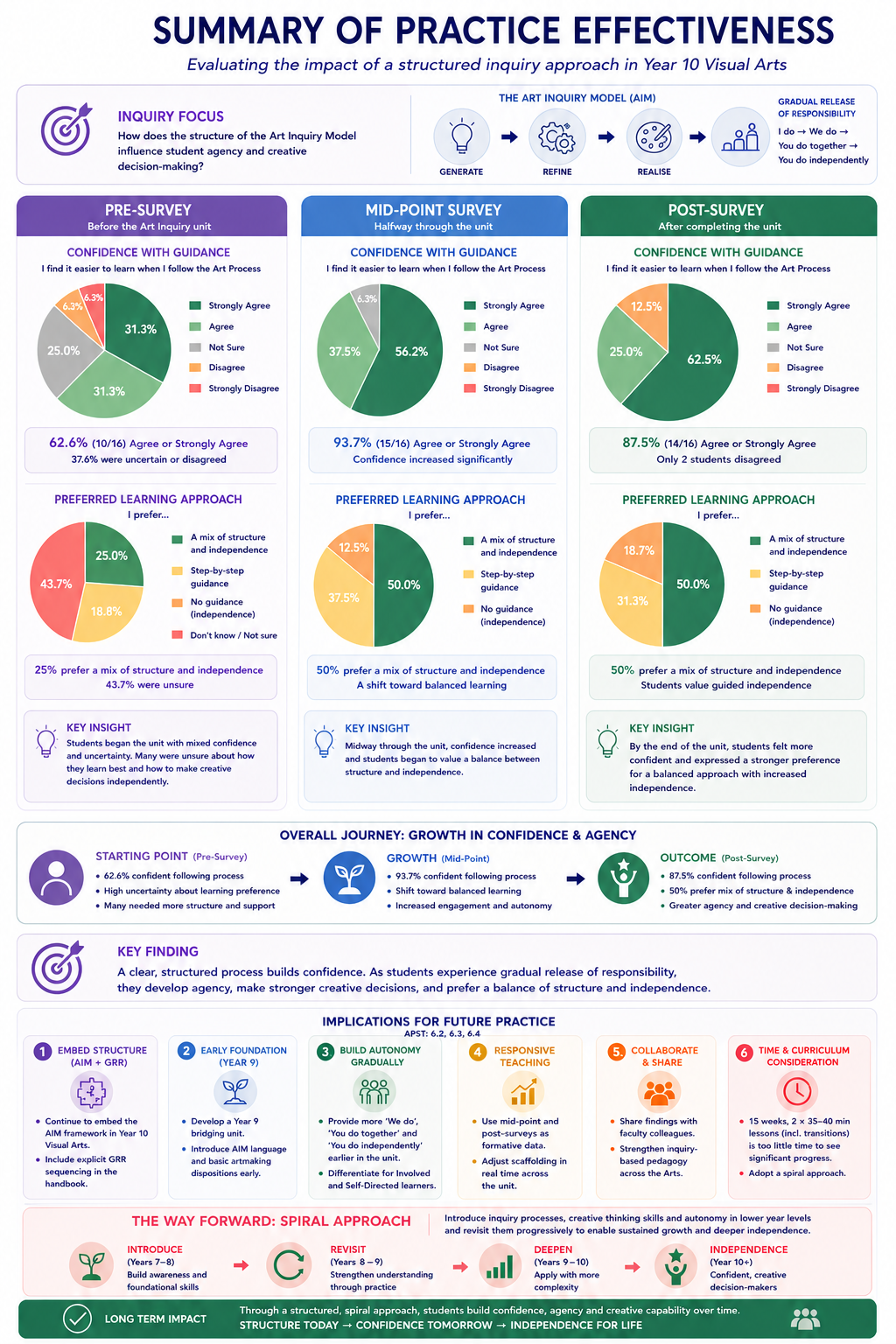
agreed the structured Art Process helped them learn. Many were unsure of their preferred approach.
agreed the structured Art Process helped them learn. Confidence increased significantly.
agreed the structured Art Process helped them learn. 50% preferred a mix of structure and independence.
Answer to the Inquiry Question
To what extent does a structured Art Inquiry Model increase student agency in creative decision-making?
The structured Art Inquiry Model increased student agency to a moderate but meaningful extent.
It improved confidence, process understanding and willingness to make creative decisions, especially when paired with gradual release and teacher feedback. However, full independence was still emerging, particularly in written reflection and idea development without teacher guidance.
What worked
Students across all three learner groups made independent creative decisions when given clear processes to follow first. The evidence consistently showed that agency grew when structure was gradually withdrawn, not when it was absent from the start.
Key growth areas
Creative Idea Generation rose 31 percentage points and Independent Decision-Making rose 23 points. The Srebrenica sketch was the pivotal agency moment, with students across all groups choosing the shoe motif independently.
Still emerging
Written reflection remained the differentiation fault line. Dependent learners demonstrated agency in visual tasks but struggled to articulate decisions in writing without direct support.
These findings are developed into five future practice actions in the Implications for Future Practice section below.
Evidencing growth, then reflecting on practice
Four rubrics triangulate process, communication and agency across all AIM phases. Visible thinking routines make student reasoning legible, and reflective prompts aligned to the APST keep teaching practice under continual review.
Rubric suite
Final Artwork Assessment
AIM Phase 5: Express
Redesigned for the Social Injustice theme. 5 criteria, scored out of 25.
APST 5.1, 2.3
Visual Diary & Process
AIM Phases 2 & 4
Assessed at the end of each phase with brief observation comments to guide next steps.
APST 5.1, 5.2, 2.1
Artist Statement
AIM Phase 5: Express
Verbal or written submission accepted. Scaffolded with dot-point templates for language disorders.
APST 5.1, 2.1, 2.5
Student Agency & Independence
All AIM Phases
Aligned to SSDL Stages 1, 4. Completed mid, point and end of unit to directly measure the inquiry question.
APST 5.1, 5.2, 5.4
Reflection routines (Project Zero)
Looking Ten Times 2
A sustained observation routine that slows perception and builds vocabulary for visual analysis.
I See / I Think / I Wonder
Structured peer critique that separates description from interpretation and inquiry.
Praise / Question / Polish
Peer review composition framework that builds constructive critique habits.
I Used to Think / Now I Think
Self, reflection routine that makes metacognitive change visible and assessable.
Teacher reflection on effectiveness
Agency emerged within structure
The Srebrenica conceptual sketch, where students across all three learner groups independently chose a near, identical shoe motif, is the strongest evidence that a structured inquiry model can produce genuine creative agency in a mixed, ability class.
Scaffolding rebuilt foundational skills
By the end of the unit, every learner group had engaged with tonal value, colour theory, observational drawing, artist analysis and conceptual annotation. Quality varied, but breadth did not. No student completed nothing.
Written reflection was the differentiation fault line
Self-directed learners completed written components fully. Involved learners completed them selectively. Dependent learners produced their richest articulation verbally. The next step is bridging oral fluency to independent written reflection.
Written reflection was the differentiation fault line, but it is worth being precise about why. For Dependent learners, the barrier was largely cognitive load: sustaining extended written thought while simultaneously processing the artmaking experience was too much to hold at once. For Involved learners, it was motivational. They could write, but did not yet see written reflection as part of their identity as an artist. For Self-Directed learners, written components were completed fully, suggesting the gap is not about literacy alone. It is about whether students have internalised reflection as a meaningful practice rather than a compliance task. The next step is not more written prompts. It is building the habit of oral reflection first, recording it, and using that as a bridge to written articulation over time.
Confidence preceded competence
Students who required the most scaffolding did not underestimate their creative capacity. The AIM framework built genuine confidence in idea, making even where technical skills remained developing.
“Students became more independent when the structure was gradually withdrawn rather than removed too early. The inquiry moved students from creative paralysis toward structured confidence.”
Overall evaluation, big insight
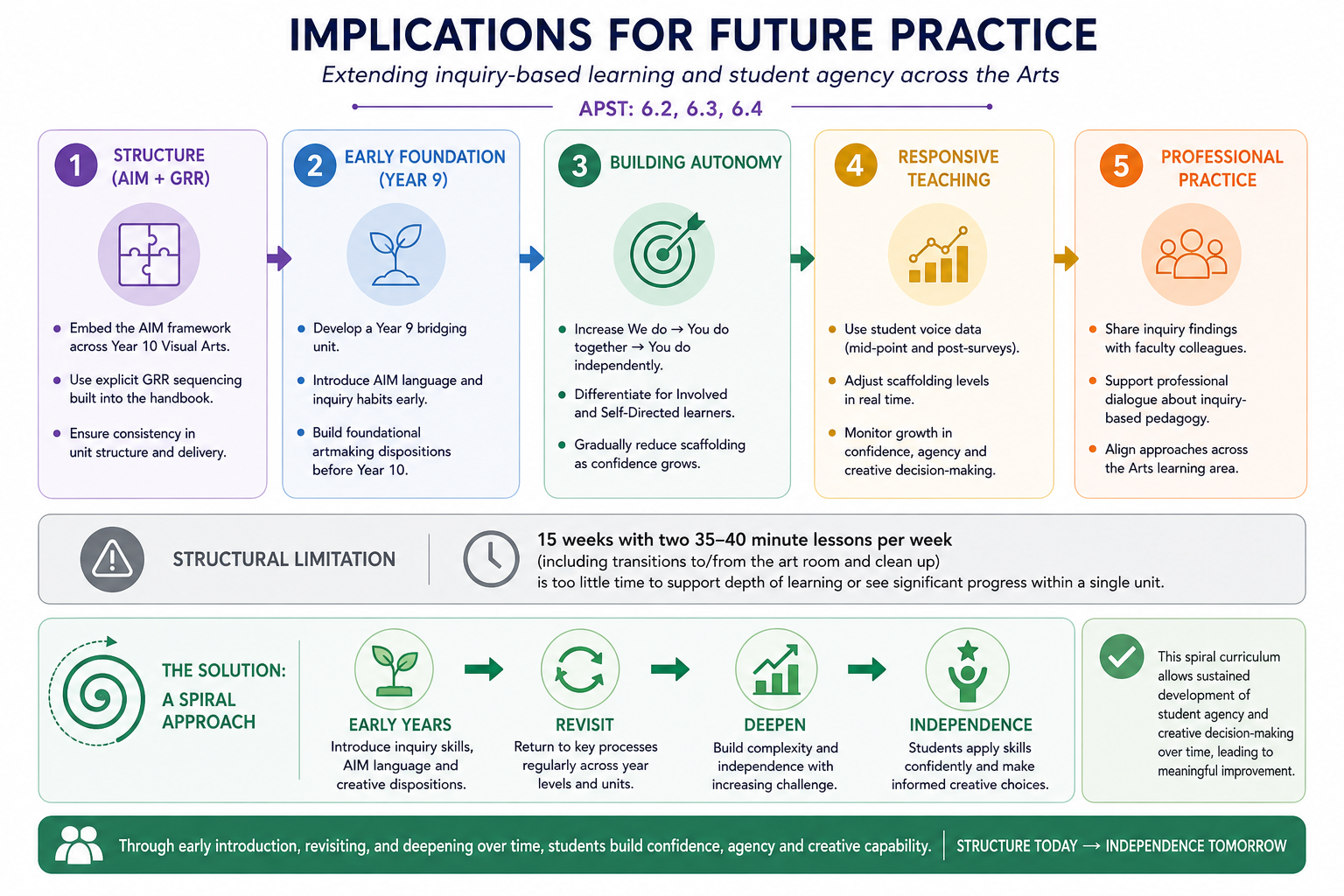
Implications for future practice, extending inquiry across the Arts.
Five action pillars for the next iteration of practice, with a spiral approach that introduces inquiry skills early, revisits them across year levels, deepens complexity, and builds toward independence.
Embed AIM across Year 10 Visual Arts. Use explicit GRR sequencing built into the handbook. Ensure consistency in unit structure and delivery.
Develop a Year 9 bridging unit. Introduce AIM language and inquiry habits early. Build foundational artmaking dispositions before Year 10.
Increase "We do" to "You do together" to "You do independently." Differentiate for Involved and Self-Directed learners. Reduce scaffolding as confidence grows.
Use student voice data from mid-point and post-surveys. Adjust scaffolding levels in real time. Monitor growth in confidence, agency and creative decision making.
Share inquiry findings with faculty colleagues. Support professional dialogue about inquiry-based pedagogy. Align approaches across the Arts learning area.
15 weeks with two 35 to 40 minute lessons per week, including transitions to and from the art room and clean up, is too little time to support depth of learning or see significant progress within a single unit. The solution is a spiral approach across year levels.
Learning that shaped the inquiry
Professional learning undertaken to support this inquiry, alongside the mentor observation and discussion cycle that grounded my practice in collegial reflection.

4
PL records
4
Mentor visits
2+
Observations
The VIT checklist requires evidence of professional learning, at least two professional discussions with a mentor, at least one observation, and at least three mentor visits. All four components are documented below.
Professional Learning Record
Visible Thinking (Project Zero, Harvard)
Embedded I See/I Think/I Wonder, Looking Ten Times 2, and I Used to Think/Now I Think routines into the Reflect phase of the AIM.
Aboriginal & Torres Strait Islander Art into the Classroom
Informed Pointillism / Aboriginal dot painting unit and ATSI artist selections in the Padlet image bank. Cultural protocols established.
Fisher & Frey Gradual Release of Responsibility
Structured the entire T3-T4 lesson sequence from "I do" through to "You do independently."
Grow's Staged Self-Directed Learning Model
Provided the framework for identifying three focus learner groups and scaffolding tiered interventions.
Mentor Visits, Observations & Discussions
Observed mentor teaching Pointillism with explicit links to Aboriginal dot painting techniques.
Strong questioning techniques and visual examples bridged technical and cultural understanding. Closed with student sharing where students explained dot density, colour and repetition choices.
Mentor observed my painting demonstration lesson. Feedback focused on clarity, structure and routine.
Demonstration lacked explicit learning intentions. Need to clearly communicate objectives and link demonstrations to upcoming lessons. Studio routines (clean-up, transitions) need explicit teaching.
Discussion on mid-point survey results and adjusting scaffolding for dependent learners.
Confirmed need to add more explicit scaffolding at T3 W3-4. Discussed bridging oral fluency to independent written reflection.
Reviewed final artwork progress and assessment moderation. Discussed child safety and wellbeing obligations.
Moderation against shared rubrics. Documented professional discussion on legal obligations for child safety and Code of Conduct enactment.
All records include date, mentor name and VIT registration number, and a written summary/reflection (full details retained in portfolio appendix).
All 37 Proficient descriptors evidenced
The Australian Professional Standards for Teachers organise practice into seven standards across three domains. Click any descriptor to view the evidence drawn from this inquiry.
7
Standards
37
Descriptors
100%
Coverage
Standard 1
Know students and how they learn
Click any descriptor card to see the evidence. Priority descriptors (1.4, 1.6, 2.4) highlighted are required by the VIT checklist.
Legal obligations and ethical practice
Reflection on the Victorian Teaching Profession's Code of Conduct alongside the legal obligations that frame every classroom decision.
Code of Conduct: Four Core Principles
Integrity
Honest inquiry into my own teaching, including acknowledging in the mid-unit reflection that students needed more explicit scaffolding than originally planned at T3 Weeks 3-4. Evidence-informed practice over performance.
Respect
Honoured the dignity of every learner: differentiated tasks, multiple means of expression, and ensured no student's cultural, linguistic or personal identity was treated as an obstacle to participation.
Responsibility
Adapted resources, modified assessment formats and additional conferencing for Dependent learners ensured that ambition for student agency did not exclude those who needed the most scaffolding to access it.
Child Safety
Compliance with the Child Wellbeing and Safety Act 2005, mandatory reporting obligations, and Ministerial Order 1359 (Child Safe Standards) embedded in classroom practice and digital tool usage.
Legal Obligations
Mandatory Reporting
As a registered teacher, I am a mandated reporter under the Children, Youth and Families Act 2005. I must report a reasonable belief that a child is in need of protection.
Duty of Care
I have a non-delegable duty of care to take reasonable steps to protect students from foreseeable harm, including in studio environments with materials, tools and digital platforms.
Child Safe Standards
Ministerial Order 1359 sets out 11 Child Safe Standards. I have actively contributed to a child safe culture through inclusive teaching, transparent communication, and reporting concerns appropriately.
How I Have Enacted These Obligations
Example 1: Wellbeing concern raised in conferencing
During a one-to-one conferencing session, a focus learner disclosed information indicating wellbeing risk. I followed school protocols immediately: documented the disclosure, escalated to the school wellbeing team and recorded the action in line with mandatory reporting expectations.
Example 2: Digital platform safety (Padlet)
When introducing the Padlet image bank, I configured permissions so student work and identifying information was not publicly visible. Image attribution was modelled to teach digital citizenship and protect student privacy in line with the Child Safe Standards.
Professional relationships with learners
The Gradual Release of Responsibility model is a professional relationship model: it requires the teacher to hold authority and guidance in early phases while progressively transferring ownership to the student. This balance demands constant professional judgement, care and ethical awareness, exercised consistently with students\' long-term development and wellbeing at the centre of every pedagogical decision.
The full set of visual references, in one place.
Every diagram used to plan, run and analyse the inquiry. Click any tile to open it full screen.
Who the learners are, what the curriculum expects, and the pedagogical models behind the response.
The full Evidence of Professional Practice document, split for easy reading.
The complete VIT submission has been split into focused subparts that follow the contents page. Pick any section or appendix on the left to open just that subpart, or download the full 197-page PDF.
Help me strengthen this inquiry
I would love to hear from fellow educators, mentors, and researchers. If you have spotted a gap in my research, have an idea I have not considered, or know of a resource that could add depth, please share it below.
Visitor Feedback
All fields except the message are optional. Your feedback goes directly to me.
Ask Sophia's Assistant
Have a question about the inquiry, the Art Inquiry Model, the findings, or my professional practice? Ask the assistant. It is grounded in my full Evidence of Professional Practice document, my presentation script, and this portfolio site.
Note, the assistant uses my inquiry materials only. For anything outside the scope of this portfolio, please contact me directly.